NEW REPORT: Small Modular Reactors – Concept Becoming Reality?


Energy
Blog · September 17, 2026

This new report explores the ongoing development of SMRs in the United States and abroad. This technology could be important for South Carolina’s future growth as the energy grid becomes increasingly pressured. DOWNLOAD THE FULL REPORT. What is the current state of energy in South Carolina? Due to increased growth, in-migration and aging power plants,


New York Judge Sides with South Carolina on $75 Billion Climate Shakedown

Energy
Blog · September 10, 2026

New York’s Climate Superfund Act, passed in 2024, sought to require American energy producers to pay roughly $3 billion per year for 25 years based on their emissions from 2000–2024. This would result in $75 billion being paid to reverse alleged environmental damages caused by these emissions. South Carolina was part of a coalition of

The 2026 SPN Annual Meeting: A Diary

Blog · September 3, 2026

On August 25th and 26th, many on the Palmetto Promise team attended the State Policy Network (SPN) Annual Meeting in Orlando, Florida. There, policy organizations from across the United States gathered to discuss freedom, federalism, and imminent threats to each. Organizations discussed freedom wins for their states on matters including education, energy, taxation, and regulation.

The Results Are In: Health Care Consolidation Works

Healthcare
Blog · August 27, 2026

Nearly two years ago, South Carolina lawmakers debated merging the state’s fragmented health care agencies. The proposal was controversial; members of the South Carolina House Freedom Caucus warned the merger would concentrate too much power in a single person, creating a “health czar”.  Today, the consolidation is showing results. In 2024, Palmetto Promise Institute produced

Ending the Utility Monopoly: Lessons from H.5440 and S.878 (R.I.P.) 

Energy
Blog · August 20, 2026

South Carolina’s electricity market remains a regulated monopoly. Utilities operate within fixed territories, leaving customers with no choice of provider, while the state government sets the rates. Palmetto Promise Institute has long advocated for Limited Retail Choice (LRC). This proven reform allows customers to purchase electricity from alternative suppliers rather than being locked into service

Powering the Palmetto State: A Market-Driven Solution to Our Looming Energy Crisis

Energy
Blog · August 13, 2026

As we all know, energy demand is a pressing issue for South Carolina. According to EIA data, South Carolina energy rates went up more than 9% last year and show no sign of slowing down. That being said, South Carolina has historically boasted energy rates below the national average, a trait that makes it very attractive to both manufacturers and residents. Recently, PPI laid out a case for Small Modular Reactors (SMRs) as a primary solution to this

Why Education Savings Accounts Are the Right Path to School Choice

Education
Blog · August 12, 2026

This op-ed originally posted in the National Review was written by Palmetto Promise Institute President Wendy Damron and Americans for Tax Reform President Grover Norquist. ESAs pair well with income-tax elimination, while tax credit scholarships don’t. In addition to being at the forefront of a national movement to drive down, flatten, and even phase out state

Does School Choice Save Taxpayer Dollars? Yes.

Education
Blog · August 11, 2026

School choice opponents commonly claim that “public dollars should go to public schools,” so anyone who wants their child to attend a private school should do so with their own, private money.  Although that can be a compelling argument, school choice opponents are actually calling for more taxpayer spending by opposing choice in South Carolina.

Palmetto Promise’s Question at the SCGOP U.S. Senate Debate

Quality of Life
Blog · August 10, 2026

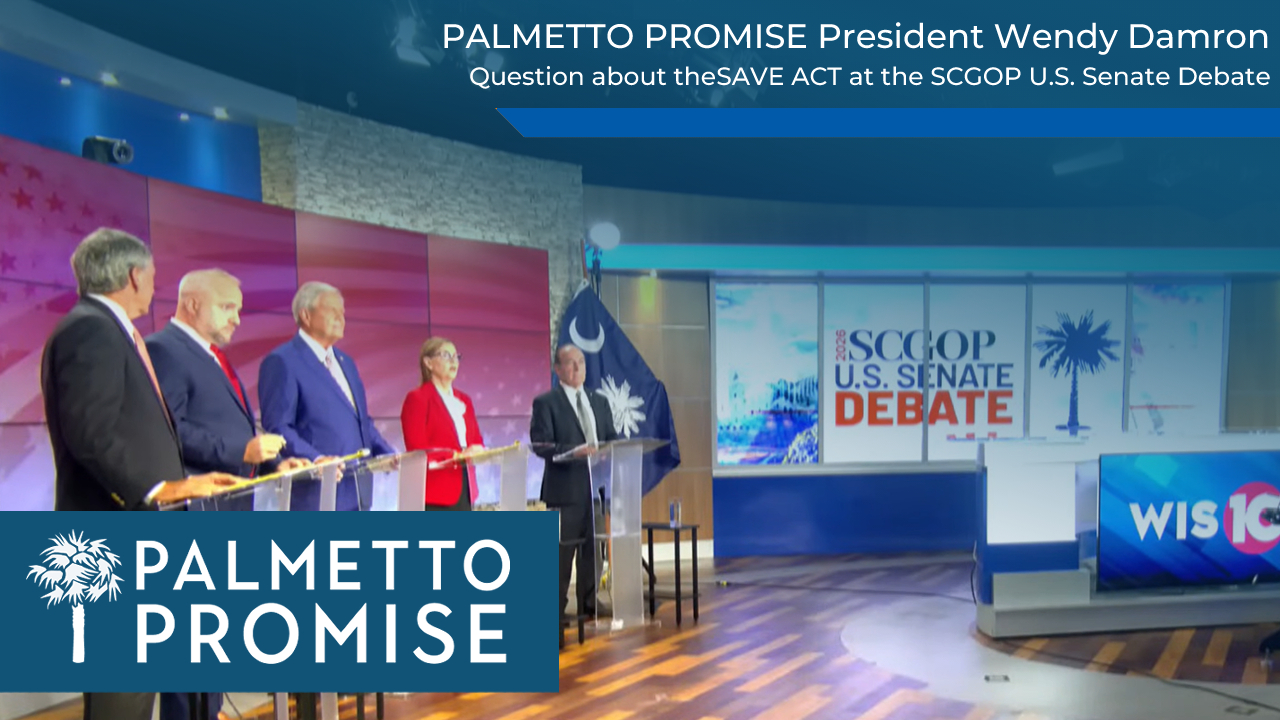
On August 3rd, during the WIS NEWS 10 SCGOP U.S. Senate debate, Palmetto Promise President & CEO Wendy Damron had the opportunity to ask candidates about the SAVE Act. The candidates: Russell Fry, Darline Graham, Mark Lynch, Ralph Norman, and Mark Sanford were posed a questions covering a variety of topics that challenge South Carolina